
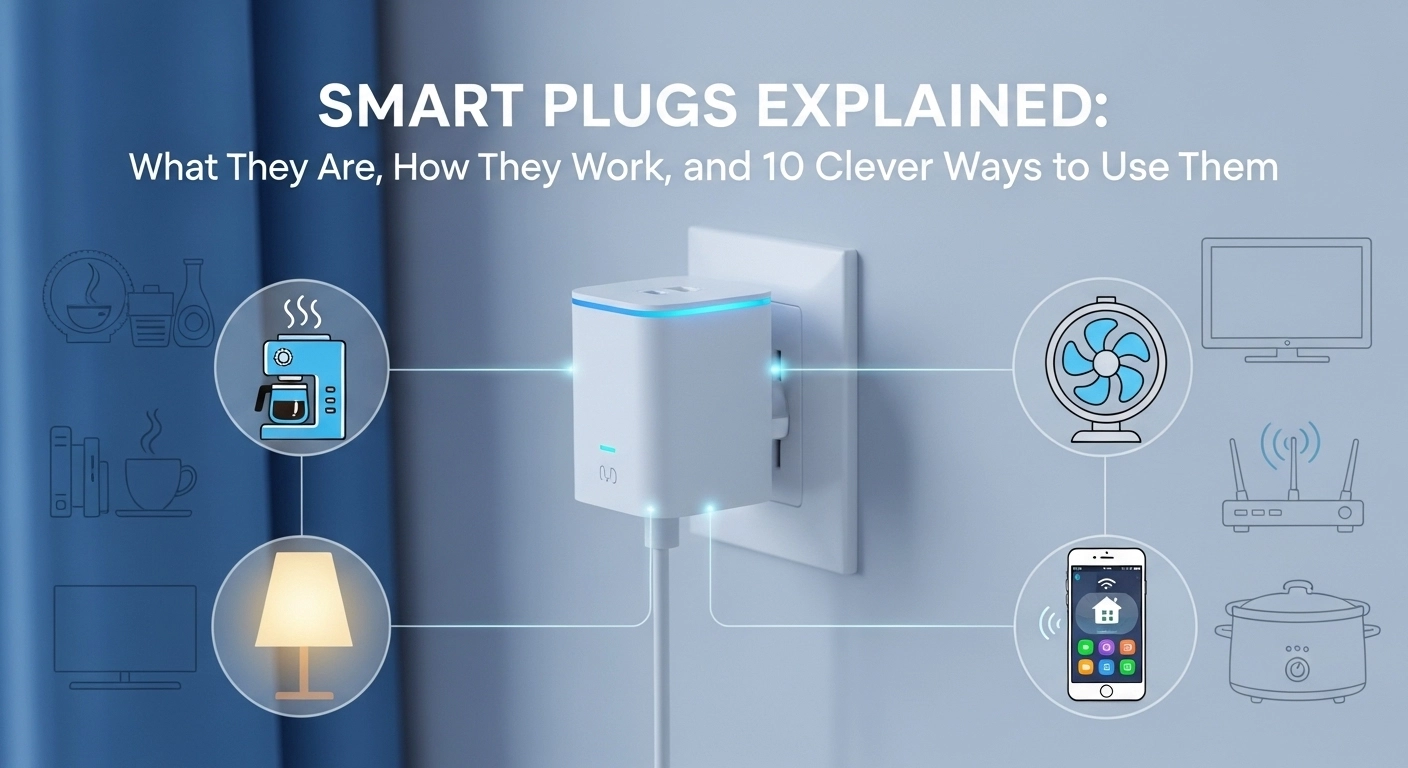
Of all the smart home gadgets on the market, smart plugs are probably the most underrated. They are small, cheap and ugly, and they do not have glossy apps or touchscreens. Yet for the price of a takeaway curry, they can transform how your household uses energy, saves time and even feels safer. If you are curious about smart homes but not sure where to start, a smart plug is probably the perfect first purchase.
Thank you for reading this post, don't forget to subscribe!This guide explains what smart plugs are, how they work, and ten practical ways to use them straight away. By the end, you will have a clear picture of why so many smart home enthusiasts end up with a drawer full of them.
What Is a Smart Plug?
A smart plug is a small adapter that sits between a wall socket and a regular appliance. You plug it into the wall, plug your lamp, kettle or heater into it, and connect it to Wi-Fi using the brand’s app. From that moment, you can switch the appliance on or off from your phone, schedule it, trigger it by voice, or link it to other smart devices.
Importantly, it does not make the appliance itself smart. Your lamp still works as a normal lamp. The smart plug just decides whether power is flowing to it. That simplicity is the whole point, and it is why smart plugs work with almost anything that has a plug.
How Smart Plugs Actually Work
Inside the plug is a small Wi-Fi chip and a relay, a tiny digital switch. When you tell the app to turn something on, your phone sends the instruction over the internet to the manufacturer’s cloud, which sends it back to your plug. The plug flips the relay, power flows, and the lamp lights up.
Some newer plugs use the Matter standard or work on a local protocol like Zigbee or Thread. These work even if your internet goes down, which is why many smart home veterans prefer them. If that feels like a detail too far, any plug that supports Amazon Alexa, Google Home or Apple Home will do the job just fine.
1. Automate Your Lamps
The classic use case. Plug your living-room and bedroom lamps into smart plugs and schedule them to switch on at sunset and off at bedtime. Set a separate morning schedule in winter so you wake up to light rather than darkness. You can also set lamps to come on when the TV starts or when your phone connects to home Wi-Fi.
2. Make Coffee Start Itself
If you have a simple filter coffee machine, load it the night before and put it on a smart plug. Schedule the plug to switch on 10 minutes before your alarm. You wake up to fresh coffee without moving a finger. This one trick has converted more people to smart homes than anything else.
3. Cut Phantom Power From Electronics
Many TVs, games consoles, hi-fi systems and chargers sip power even when off. Over a year, the cost adds up. Put them on a smart plug and set the plug to cut power completely at night. You save money, and the devices get a gentle reset each morning, which sometimes fixes minor glitches.
4. Safer Heaters and Electric Blankets
Leaving a space heater or electric blanket on is a genuine fire risk. A smart plug with a timer lets you set it to switch off automatically after, say, 30 minutes, even if you forget. Some models also track energy use and send alerts if the appliance stays on far longer than usual.
5. Fake Being Home When You Are Away
A house with no lights on for a week looks abandoned. Program your living room lamp, kitchen radio or TV on a smart plug to follow a natural evening schedule while you are on holiday. It is one of the cheapest, most effective burglar deterrents ever invented, and it runs completely automatically.
6. Control Hard-to-Reach Devices
If your router sits behind the sofa, or your Christmas tree lights plug in behind a bookshelf, a smart plug saves you bending down every time. A voice command or a tap in the app does the job, which is brilliant for anyone with mobility issues, back pain or very small children.
7. Monitor Energy Use
Many modern smart plugs, including TP-Link Tapo, Eve Energy and Meross, measure how much power a device uses. You can see exactly how much your fridge, tumble dryer or gaming PC costs to run in real terms. Armed with this data, you can decide which old appliances are worth replacing with more efficient ones.
8. Use With a Pet Feeder or Fish Tank
Pet feeders and fish tank heaters or lights pair beautifully with smart plugs. Schedule feeding times, aquarium lighting cycles or reptile heat lamps with precision. For holiday sitters, it means less to explain. They just have to top up the food; the plug does the rest.
9. Back Up With Away Mode
If you accidentally leave the iron, straighteners or a space heater on, you can switch them off from anywhere using the app. This is one of those features you hope you never need but appreciate the first time you remember a switched-on appliance halfway to work.
10. Create Routines and Scenes
When your smart plugs are linked to Alexa, Google Home or Apple Home, you can bundle them into routines. A single “Good Night” command can turn off the lamps, the TV, the PlayStation and the kettle in one go. A “Movie Time” routine can dim lights, switch on the amp and start the projector. This is where smart homes genuinely start saving daily minutes.
Buying Tips
For most UK homes, a pack of four budget smart plugs from TP-Link Tapo, Meross or Amazon’s own brand is the best starting point. Look for plugs that support Matter, Alexa and Google Home to keep your options open. Pay a little more for energy monitoring if you want to track consumption.
Final Thoughts
Smart plugs are the quiet workhorses of the smart home. They are cheap enough to experiment with, easy enough to set up in minutes, and flexible enough to solve dozens of problems around the house. Buy two, try them on your lamps and coffee machine for a fortnight, and see how quickly you start thinking of new uses. Most households end up adding more within the month, and that is exactly how a useful smart home grows.